Part One — Where It All Starts
Before any theory, there was a held note. The drone shows us how readily the ear accepts a centre, and how much physics can and cannot explain about it.

Sit near a Hindustani classical performance and the first thing you hear is not a melody. It is the tanpura, a long-necked lute whose four or so strings are plucked in a slow cycle and never stopped. It plays no tune. Its job is to sound the tonic, called Sa, together with its fifth or another chosen note, for as long as the performance lasts. Every phrase the singer offers is heard against it. The drone does not argue for a home; it simply occupies it.
The Highland bagpipe does something similar with its three drone pipes, and so, in their own ways, do the hurdy-gurdy, the Sardinian launeddas and the organ pedal point at the end of a Baroque fugue. Wherever the device appears, listeners report the same thing: notes that agree with the drone feel settled, notes that clash with it feel charged, and the melody seems to orbit the held pitch. This is our first piece of evidence, and it is worth stating carefully. A sustained note is remarkably good at becoming a centre. That is not yet a theory of why.
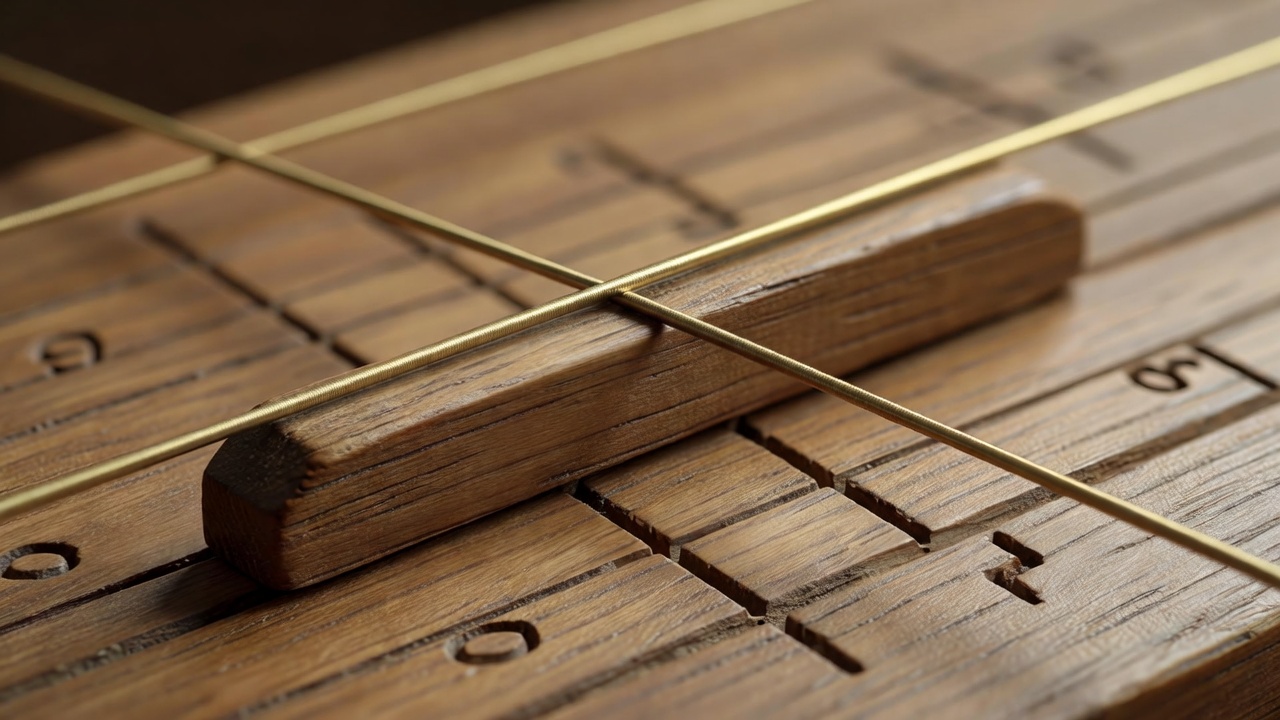
The ratios on the monochord
The oldest attempt at a why is traditionally credited to Pythagoras, though the stories about him are late and partly legendary. What survives, through later writers, is the observation that strings whose lengths stand in simple ratios produce intervals that sound smooth together: 2:1 for the octave, 3:2 for the fifth, 4:3 for the fourth. A home note, on this view, is simply the reference against which these clean proportions are measured.
The idea is elegant, and partly right. The octave really is heard as a kind of sameness across almost every documented musical culture; a melody sung by a man and a woman an octave apart is perceived as one melody. The fifth is very widely privileged too. But ratios alone do not tell us which note of a scale will be heard as home. In a C major scale, G stands in a perfect 3:2 relation to C, yet we do not hear G as the tonic. Something else is choosing.
The physics hands us a short list of candidates. It does not pick the winner.Part One
Helmholtz and the overtone series
In 1863 the physicist and physiologist Hermann von Helmholtz published On the Sensations of Tone, which moved the question from string lengths into the ear itself. A single plucked string, he showed, does not produce one frequency but a stack of them: the fundamental plus overtones at two, three, four and five times its frequency, and onwards. Within that stack sit the octave, the fifth and the major third above the fundamental. On this account, a major triad is a kind of magnified echo of one note's own spectrum, and the note at its root has a natural claim to be heard as the source.
Helmholtz also explained roughness: when two tones have overtones that nearly but not quite coincide, they beat against each other, and we hear friction. Simple ratios share more overtones and beat less. This gives a plausible acoustic reason why a drone makes some notes feel at rest and others restless.
Yet Helmholtz himself was cautious. He wrote that the system of scales and harmony is not simply a product of nature, but also the result of aesthetic principles that have changed with the progress of human culture. That sentence deserves more attention than it usually receives. The overtone series explains why certain intervals are stable. It does not explain why the minor key, whose third does not appear early in the series, feels just as much like home to millions of listeners.
What the drone teaches
So where does this leave us? The drone shows that the ear will accept a centre when one is offered persistently. Acoustics shows that some relationships to that centre are smoother than others. Together they give the tonic a physical footing, a reason why octaves and fifths so often frame musical homes across very different traditions.
But notice what the drone has done: it has supplied the tonic by brute repetition. Most Western music has no drone. A pop song or a Schubert song must persuade you of its home with moving notes and changing chords, and it usually succeeds within a few seconds. To understand how, we need to leave the physics laboratory and enter the grammar of harmony, where the tonic stops being a held sound and becomes a destination.